The role of a digital crowdsourcing platform in the service process
Serving customers in real time and with high quality with a limited number of service technicians is a challenge. Can companies use crowdsourcing to increase service efficiency and thus customer satisfaction?
Challenges in the service process
In the age of digitalization, companies face significant challenges regarding staffing needs and service volume. Customers expect a rapid response to service requests, ideally in real time. Technologies like the Internet of Things enable devices to automatically send service messages to service pools. This poses a problem for many companies, as they often lack sufficient staff for quick processing. Increasing staffing levels is expensive, and skilled professionals are scarce. Crowdsourcing offers a solution to optimally meet the needs of both customers and companies (Figure 1).
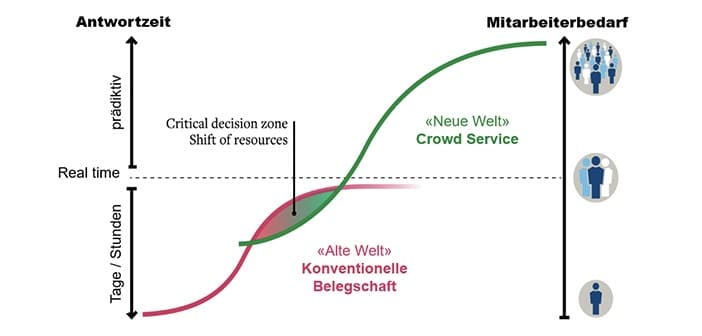
Crowdsourcing explained simply
The term “crowdsourcing” is a combination of the words “crowd” (community, large group of people) and “outsourcing” or “sourcing.” It refers to the outsourcing of business tasks or services to an external group of volunteer contractors via the internet. The goal is to involve users in the work and creative processes of companies. This is not always about a purely commercial endeavor. The online encyclopedia Wikipedia is a good example: web users voluntarily contribute articles to the portal. An example of a commercial crowdsourcing platform from Switzerland is “Mila.” This digital platform allows users to search for, book, and rate technically skilled individuals.
A dedicated digital marketplace connects external specialists with professionals at any time of day.
A cloud-based crowdsourcing platform allows you to create your own crowd service, essentially operating your own digital marketplace. You build a network of external specialists, employees of partners and customers, and volunteers. The service process on this marketplace could function as follows: The customer selects the desired service, explains their problem, and specifies the desired time for the service call. Finally, the service location is confirmed. The request, now complete with all relevant information, is processed in real time. With automatic skills and location validation, the request is quickly forwarded via app to the appropriate external employee for completion.
Crowdsourcing increases service efficiency and customer experience
A digital Crowdsourcing platform increases speed Service delivery is faster because external staff typically respond to requests in real time. Furthermore, the geographic coverage denserA comprehensive digital service network makes it possible to find excellent employees. This helps a company reduce the risk of staff shortages. Furthermore, This reduces the costs of recruiting and training.Crowdsourcing improves service quality And that automatically increases customer satisfaction.
Sources
Mrass, V. & Peters, C. (2018): DDigital value creation through crowd services: New forms of customer support using Mila and Swisscom as examples. In: Robra-Bissantz, S. & Lattemann, C. (Eds.), Digital Customer Experience – acquiring and retaining customers with digital services (Vol. Edition HMD). Wiesbaden, Germany:Springer