SAP Business ByDesign – 2023 Review and 2024 Outlook
Hear firsthand from Rainer Zinow, SVP, Head of SAP Midmarket Product Management, what was achieved with SAP Business ByDesign in 2023. You will also get an outlook on SAP’s plans for 2024.
SAP Business ByDesign is an integrated, cloud-based ERP (Enterprise Resource Planning) solution for small and medium-sized businesses. The business software offers a comprehensive suite of tools and features that help companies manage various aspects of their operations.
These business management tools cover all key areas, from finance and customer relationship management (CRM) to human resources and inventory management. Integrating all data into a central system simplifies administration, making it clearer, more efficient, and less prone to errors.
Advantages of SAP Business ByDesign for SMEs
SAP Business ByDesign It is particularly suitable for companies with up to 500 users who prefer a cloud-based solution.
On-demand solutions, often referred to as Software-as-a-Service (SaaS), offer several advantages, including:
- Low initial costs: Typically, on-demand solutions like SAP Business ByDesign require little to no initial investment in hardware or software. This reduces the financial burden for businesses, especially small and medium-sized enterprises (SMEs).
- Scalability: SAP Business ByDesign is easily scalable. Companies can add or remove users and adjust their capacity at any time to accommodate growth or seasonal fluctuations.
- Maintenance and updates: The company itself doesn’t need to worry about the maintenance, updates, and security of the software because the SaaS provider is responsible for that. Users automatically have access to the latest features and updates without any additional costs or effort.
- Data security: SaaS providers often invest heavily in security measures and infrastructure to protect their customers’ data. This typically ensures the protection of sensitive data and compliance with industry-specific regulations.
- Accessibility and diversity of use: The web client and cloud-based data storage offer employees greater mobility, as they have access to their data anytime, anywhere via a stable internet connection. This enables work from various locations and supports remote work and home office arrangements. SaaS applications are typically available across different devices and operating systems, further increasing their versatility.
- Fast implementation: SaaS solutions are generally ready for use quickly, as neither complex installation nor lengthy configuration is required.
- Automatic backups: Most SaaS providers offer regular data backups and recovery services to prevent data loss.
- Cost forecast: Due to the monthly or annual subscription fees, companies have a clear idea of the operating costs, which facilitates budgeting.
- Working globally: For internationally operating companies, the SAP Business ByDesign ERP system stands out due to its global usability. It supports multilingualism and has multiple currency capabilities.
SAP Business ByDesign: Review and Outlook
For a quick overview of SAP Business ByDesign: Watch this 2-minute video (in English) with a review and outlook.
What modules does SAP Business ByDesign offer?
This business management tool in the ERP cloud guarantees your company, above all, efficiency and productivity. Its high level of user-friendliness, data security, and the guarantee of expert support from DATA UNIT make SAP Business ByDesign an ideal tool for SMEs.
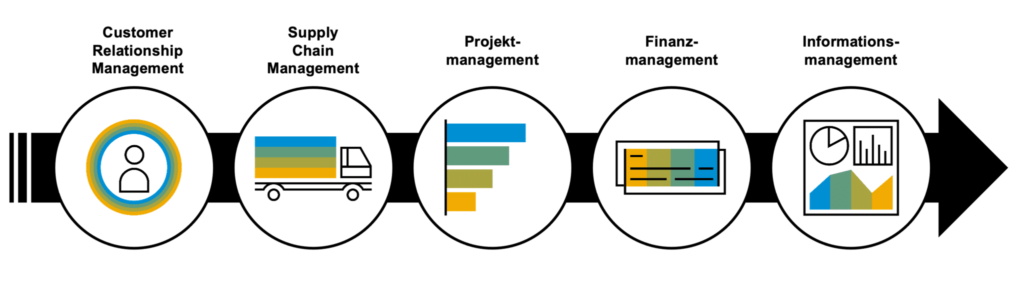
Finance and accounting
In addition to real-time external and internal accounting, cash flow management and the automation of financial processes ensure that you have a constant overview of your company’s current financial situation. This supports cost control. Compliance is also guaranteed. The software can be easily adapted to the legal standards and regulations applicable in Switzerland or locally.
Customer relationship management
With a CRM (Customer Relationship Management) tool, you can clearly manage all customer interactions, track sales and service processes, and organize marketing campaigns. It helps you effectively build and manage customer relationships from the outset, which benefits the company’s growth.
Personnel and resource management
Human resources management is simplified and standardized. SAP Business ByDesign supports both recruitment and… Onboarding new employees, as well as time tracking, self-service functions and payroll.
Supply Chain Management
SAP Business ByDesign makes supply chain management seamless and transparent. It covers everything from purchasing and inventory management to order processing and supplier relationship management. It also includes product development, forecasting, manufacturing, Warehouse management Logistics can be processed with this tool.
Built-in Analytics
SAP Business ByDesign offers extensive analysis tools, such as KPI (Key Performance Indicators) and report monitoring, multidimensional reporting and analysis functions, dashboards, Excel-based reporting and open APIs (Application Programming Interfaces).
Project management
With the ERP system SAP Business ByDesign also makes it easier and more efficient to plan, execute, and monitor projects because it ensures collaboration across all functional areas. This is particularly useful for service-oriented industries and companies with complex project requirements.
Compliance with tax regulations
SAP Business ByDesign offers a wide range of functions and tools to help your company comply with tax regulations in different countries and regions. This includes defining tax rates, tax types, and tax rules that are applied to business transactions.
Implementing SAP Business ByDesign: Step-by-step instructions
Implementing SAP Business ByDesign typically requires the support of an SAP expert or an implementation partner. Most implementations are complex and must be tailored to the specific requirements of the company. Therefore, it is advisable to seek professional support, such as from… Experts from Data Unit to be consulted.
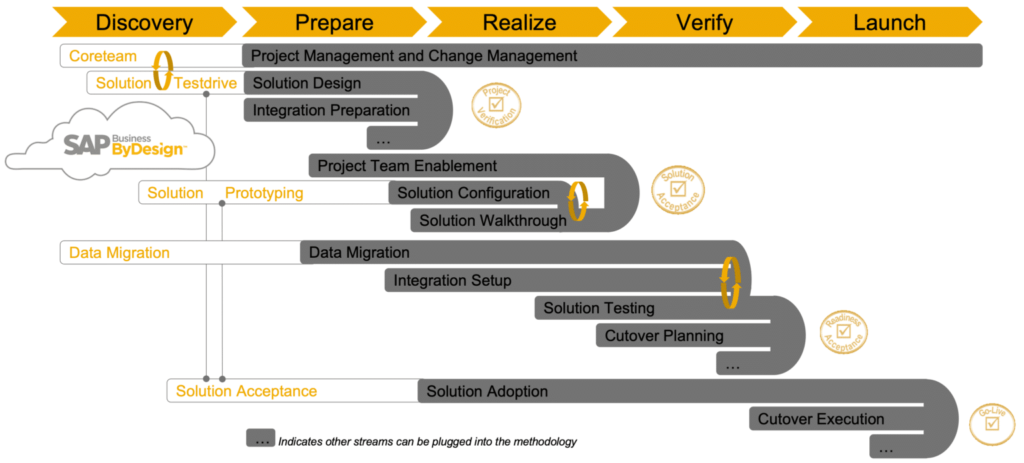
The implementation process is as follows:
1) Preparation and planning
Identify and analyze the business requirements and implementation goals. Assemble a team responsible for managing the SAP Business ByDesign implementation and create a project plan.
2) Evaluation and licenses
Discuss the licensing costs and terms of the new ERP system with your SAP partner to determine which is best suited to your company and the legal requirements in Switzerland. Establish a budget for the implementation that covers software licensing costs, hardware costs, training costs, and other expenses.
3) Data migration
All important data, such as customer, supplier, product, and financial information, is transferred to the new ERP system. Then, it is configured and specifically customized to meet Swiss legal requirements and all of the company’s needs. This may include setting VAT rates, language adjustments, complying with data protection regulations, or adhering to local requirements.
4) Training
All employees who will be working with SAP Business ByDesign must be trained and prepared for the transition. In addition to formal courses, SAP offers numerous online resources. Interested individuals can deepen their knowledge and find answers to their questions through videos, documentation, and user forums.
5) Testing and pilot phase
Comprehensive testing ensures your ERP system functions as intended. Any identified errors are resolved, and the system is retested until everything runs smoothly. During the pilot phase, SAP Business ByDesign is deployed on a limited scale to test its practical suitability.
6) Data migration and go-live
All remaining or necessary data will be integrated into SAP Business ByDesign and official operations will begin.
7) Ongoing support and maintenance
Creating a support plan is necessary to ensure the smooth operation and maintenance of SAP Business ByDesign. Monitor the performance of the ERP software and ensure it meets all business requirements and objectives.
How much does SAP Business ByDesign cost?
SAP Business ByDesign is typically billed via monthly or annual subscription fees per user. The price varies depending on the number of users, the required modules and features, and any necessary additional services and customizations. We create customized quotes for each company based on its specific requirements.
There are four components to consider when calculating the price:
- The costs for implementing the software vary depending on the complexity of the project and the necessary customizations.
- With the cloud solution, there may be hardware costs for end devices and network infrastructure.
- The cost of software licenses varies depending on the number of users and the desired features.
- There may be costs for training users and administrators so that they can use the new system effectively and constructively.
A personal consultation with our experts allows us to not only provide a comprehensive assessment of your company’s situation, but also an overview of the total costs incurred over the usage period.
Ensure you have a clear understanding of the total cost of ownership to make informed budget decisions and avoid unexpected expenses during the implementation and ongoing use of SAP Business ByDesign.
However, it’s important to note that SaaS solutions are not suitable for every company or application. Before opting for an on-demand solution, you should consider the specific requirements and characteristics of your own business.Roger Wipfli (Chief Sales Officer – DATA UNIT)
The decision to implement an ERP system is based on a careful assessment of the company’s specific needs, budget, and growth plans. Therefore, consult with the experts at Data Unit to find the best ERP system for your unique business.
Take the next step for your business with SAP Business ByDesign. Click here to schedule a personalized demo!

SAP Business One (SAP B1) is an ERP software specifically designed for small and medium-sized enterprises (SMEs). ERP stands for Enterprise Resource Planning and describes software that allows for the centralized management of various areas of a company. SAP Business One enables SMEs to gain greater control and oversight of all business processes and does not require the complex functional components offered by large ERP systems.
SAP Business One is a standard business software suitable for companies with up to 250 users. This makes the software ideal for start-ups and subsidiaries of large companies.
What are the advantages of SAP Business One?
SAP Business One can be flexibly adapted and extended to meet specific business requirements.
By networking the business units, the workload caused by duplicate and often inaccurate data entry is reduced. This digital data transparency makes it possible to better monitor and manage the company.
Since SAP Business One is designed for small and medium-sized businesses, the software also impresses with its pricing and rapid implementation time. The cloud version, in particular, is productive after just a few weeks. Thanks to its intuitive interface, employee training requirements are kept to a minimum.
Which modules does SAP Business One include?
The ERP system connects all areas of the company, ensuring seamless and transparent business processes. It offers a comprehensive suite of business applications that includes finance, sales, purchasing, inventory management, and production.
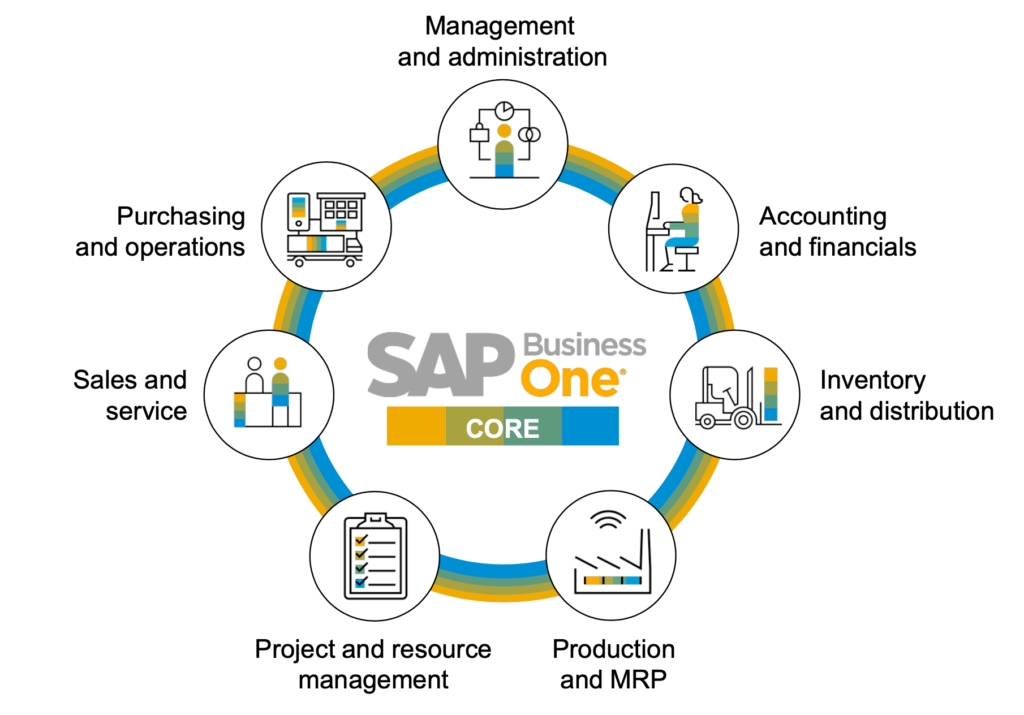
Financial management
The ERP software supports not only accounting but also controlling. The most important accounting processes can be automated. SAP Business One monitors cash flow and controls the budget.
The system can also handle banking transactions, including account reconciliations, as well as the management of fixed assets. Planning, auditing, and review processes are supported and simplified by standardized and customized reports with real-time data.
Customer data management
SAP Business One includes an integrated Customer Relationship Management (CRM) system that allows you to efficiently manage and shape your customer relationships. The software provides an overview of the entire customer lifecycle, from initial contact to post-sales support.
Warehousing and distribution
Managing deliveries is time-consuming and error-prone when done manually. SAP Business One enables precise inventory tracking, which… Accuracy and efficiency of warehouse management Significantly improved. It monitors inventory levels in real time, tracks deliveries, and effectively controls stock movements.
Furthermore, SAP Business One offers inventory forecasting capabilities to prevent overstocking or shortages. This leads to reduced storage costs and improved cash flow. An automated, streamlined, and faster delivery process further enhances customer satisfaction.
Business intelligence
Numerous analytics and reporting tools produce up-to-date and accurate reports using data from across the entire company. These reports can be customized. The data is transformed into meaningful information, enabling better strategic decisions that ensure the company’s growth and success.
You can find more information in our blog article: The analytical capability of business intelligence.
Web client
All authorized employees can access selected master data and processes in SAP Business One via the web client. The focus here is on creating, editing, and maintaining sales documents, items, activities, and data from contacts and business partners.
Extensions: Add-ons for SAP Business One
SAP Business One is modular and can be adapted to different industries and company structures. Service-oriented companies use it for professional planning of technicians, vehicles, materials, and tools. Field Service Management.
Other possible expansions exist for production, trade, and services. These include, among others: Finance Package (advanced financial tools), Scan and Attach (Document management system) or Swiss Salary (Payroll accounting specifically for Switzerland).
SAP Business One on-premise or in the cloud
There are two ways to run SAP Business One: either locally in the company (on-premise) or in the cloud.
On-premise This means “on-premises.” SAP Business One is installed and operated on the company’s own servers. The main advantage of this solution lies in the company’s complete control and ownership of the IT infrastructure and software.
In some cases, a local installation can be more powerful than the cloud solution, especially when dealing with resource-intensive applications.
It is also possible to adapt on-premise software more closely to the specific needs of a company, as there are no restrictions imposed by cloud providers.
Advantages of SAP Business One On-Premise:
- Compliance with internal data security guidelines
- Direct control and access to the data
- Business processes can be adapted and expanded more efficiently.
- Use of internal hardware and existing IT infrastructure and resources. Responsibility for maintenance and updates lies with the company.
- While perpetual licensing means higher initial costs, it results in lower overall costs in the long run. This leads to greater transparency and better cost control, as there are no recurring subscription fees for cloud services.
- In some industries and regions, on-premise solutions are necessary to meet regulatory requirements.
However, it’s important to note that an on-premises solution can also have disadvantages, such as higher initial investments and responsibility for maintenance. Additional IT investments may also be necessary if existing hardware resources are insufficient.
During an installation in the cloud The software is hosted in an external data center. You pay a monthly fee for the necessary IT resources and licenses. IT overhead is significantly reduced because hosting is handled by an external partner.
Advantages of SAP Business One in the cloud:
- Fast and cost-effective implementation
- Secure browser-based access from anywhere, anytime.
- Access to the latest features without having to rely on internal IT staff.
- Business functions can be managed in a web browser.
More information about the topic SAP Business One Cloud vs. On-Premise can be found on our blog.
There are good arguments for both versions. Which one is ultimately best for your company depends on numerous factors, such as the available budget or the existing IT infrastructure.
Costs and price of SAP Business One
SAP Business One generally offers excellent value for money, especially for SMEs. It is characterized by its quality, wide range of functions, and low cost.Roger Wipfli (Chief Sales Officer – DATA UNIT AG)
The costs for SAP Business One can vary and depend on several factors, such as the size and objectives of the company, the number of users, the implementation method (on-premise or cloud), and the specific requirements of the company or industry. There are four components to consider:
- The costs for implementation The software costs vary depending on the complexity of the project and the necessary or desired customizations.
- The costs of operating the system It depends on whether it’s an on-premises or cloud solution. On-premises solutions may incur hardware costs for servers and network infrastructure.
- The costs for the software licenses depend on the number of users and the desired functions.
- The costs for the training by users and administrators, in order to use the software effectively.
With our cost calculator You can request a free, no-obligation price quote for your company. A personal consultation with the experts at DATA UNIT AG will not only provide a comprehensive assessment of your business situation but also an overview of the total costs incurred over the entire duration of your SAP Business One implementation. Contact us today!ernehmen erstellen lassen. Bei einem persönlichen Gespräch mit den Experten von DATA UNIT AG lässt sich nicht nur eine umfassende Bewertung der Unternehmenssituation ermitteln, sondern auch ein Überblick über die Gesamtkosten, die sich über die Laufzeit der Nutzung von SAP Business One ergeben. Kontaktieren Sie uns noch heute!
From January 1, 2024, an increase in value-added tax (VAT) will come into effect in Switzerland. The standard rate will increase from 7.7% to 8.1%, the reduced rate will be 2.6% instead of 2.5%, and the special rate for accommodation will be 3.8% instead of 3.7%.
This increase is an important fiscal policy measure to ensure Switzerland’s long-term financial stability. General inflation and rising expenditures in healthcare, education, and infrastructure necessitate more funding. The VAT increase is intended to close part of the funding gap.
| VAT rates | Valid from October 01.01.2024st, XNUMX | Valid until 31.12.2023 |
| Standard rate | 8.1% | 7.7% |
| Reduced rate | 2.6% | 2.5% |
| Special rate for accommodation | 3.8% | 3.7% |
The VAT increase This has an impact on everyone, citizens and businesses alike. Small and medium-sized enterprises in particular need to prepare thoroughly to comply with the administrative requirements.
What are the effects of the VAT increase?
The VAT increase often leads to price increases. Companies have to pay more in taxes, and in most cases, they pass this increase on to customers by also raising the prices of their services and products.
This, in turn, affects consumer behavior. Since customers have higher living costs, they carefully consider what they want to spend their money on.
Cost management of the VAT increase
Companies face the challenge of covering rising tax costs while maintaining profitability and competitiveness. VAT is a significant component of pricing and can impact a company’s success.
This switch to the new tax rate can lead to staffing and/or resource problems, especially for small and medium-sized enterprises (SMEs). Companies risk having higher prices than their competitors after the adjustment, which can negatively impact their budget and profitability.
Companies should therefore carefully consider in which areas or for which products price adjustments are made. Short-term offers, discounts, and price reductions can sweeten the bitter pill for customers.
Legal aspects and compliance with VAT increases
The planned VAT increase in Switzerland in 2024 will not only bring economic changes but also have implications for legal aspects and tax compliance. Companies must meet the new legal requirements to avoid potential legal consequences. Here are some key points regarding legal aspects and tax compliance:
1. Adaptation to new VAT rates:
The new VAT rates need to be integrated into accounting systems and business processes. This may require updates to sales and invoicing systems to ensure the correct tax rates are applied.
“ERP systems are generally prepared for VAT changes. In the case of SAP Business One, this takes approximately fifteen minutes. This includes all special cases with the new tax rate in 2023 or the old tax rate in 2024, as well as updating the VAT form. The VAT codes remain unchanged; the rates are controlled by the posting date. I recommend integrating these adjustments early on.”
Bruno Mühlebach, ERP Consultant
ERP systems such as SAP Business One or SAP Business by Design They allow for a relatively simple transition, while decentralized or outdated management systems often involve more personnel and labor costs. Should you have any questions or doubts, please contact our ERP experts. You can also find further information in our wiki. How to adjust tax rates in SAP Business One or in the following video.
2. Tax documentation:
Accurate documentation of transactions ensures that all tax records are properly maintained, including invoices, receipts, and records of VAT payments. This facilitates compliance with tax regulations and audits by the tax authorities.
3. Review of existing contracts:
Existing contracts should be reviewed to ensure they correctly reflect the new VAT rates. This may include contracts with suppliers, customers, and service providers. If necessary, contracts must be amended and renegotiated.
4. Timetable for the VAT increase:
Businesses must closely monitor the timing of the VAT increase and ensure they apply the new rates from that point onward. This can have a significant impact on invoicing cycles and payment deadlines.
Neither the invoice date nor the payment date is decisive for the applicable tax rate. Only the date the service is rendered counts. Therefore, the increase can already apply to invoices issued during 2023.
This applies particularly to invoices issued in 2023 that fall wholly or partially into the 2024 service period, such as partial payment invoices, advance payment invoices or invoices for periodic services.
Conversely, this also applies to 2024 if subsequent reductions in remuneration and returns are received that fall within the 2023 performance period.
Which industries are most affected by the VAT increase?
The impact of the VAT increase depends on various factors, including specific business models, the competitive landscape, and consumer response. Some sectors will therefore be more affected by this change than others.
1. Retail:
The retail sector is often most directly affected by VAT increases, as price hikes are passed directly on to customers. Consumers may become more hesitant to purchase products that have become more expensive due to the tax increase. This could potentially lead to a decline in sales in certain areas.
2. Gastronomy and tourism:
The hospitality and tourism industry is particularly sensitive to price fluctuations. Higher VAT rates can lead to rising prices for restaurants, hotels, and leisure activities, negatively impacting demand.
3. Construction and real estate sector:
The construction and real estate sector could also be affected by the VAT increase, as it raises the costs of construction and renovation projects. This, in turn, impacts the demand for real estate and construction projects.
4. Healthcare and Education:
Services in the healthcare and education sectors are generally exempt from VAT, but indirect effects can still be felt. Rising living costs could strain people’s budgets and affect their willingness to invest in healthcare and education services.
5. Luxury goods:
The luxury goods industry is generally less affected by the VAT increase. Buyers of luxury goods are usually not as price-sensitive when prices rise.
6. Export-oriented companies:
Export-oriented companies will also be less affected by the VAT increase. They primarily sell their products abroad, and in this case, a tax increase has less of an impact on prices and competitiveness.
Tips and best practices for increasing VAT
1. Early preparation:
Start preparing for the VAT increase early. The more lead time you have, the better you can adjust to the changes.
2. Thorough training:
Train your staff, especially those responsible for accounting and tax compliance. Ensure they understand and can apply the new VAT rates and regulations.
3. Software update:
Check your accounting and invoicing systems for updates to ensure you can correctly apply the new VAT rates. Make sure your software provider delivers the necessary updates.
4. Review of contracts:
Review existing contracts and agreements to ensure you correctly account for the VAT increase. If necessary, amend contracts and explain the price increase to your contractual partners.
5. Regular monitoring:
Establish regular monitoring mechanisms to ensure that VAT rates are applied correctly. This may include internal audits and controls.
6. Transparency in communication:
It is advisable to explain the price increase to customers clearly and transparently. This strengthens customer trust and prevents misunderstandings. Special offers and discounts can mitigate the impact on customers.
7. Expert consultation:
Consult tax experts and accounting advisors to ensure you are following best practices for your specific situation.
8. Keep the documentation:
Keep detailed records of all tax transactions and VAT payments. Accurate documentation is crucial to demonstrate compliance.
9. Cash flow management:
In cash flow management, companies must ensure they have sufficient liquidity to pay the higher taxes without jeopardizing their operational activities.
If your company already uses an ERP system, the transition to the VAT increase will proceed without major problems. If you are considering purchasing such a system, speak with one of our experts and let them explain and demonstrate its advantages.

In today’s ever-evolving business world, having efficient and robust technological tools at your disposal is crucial. This is what ensures a company’s success.
In this context, SAP Business One It has established itself as a leading solution. It meets the needs of SMEs worldwide in terms of management and operations.
Whether it’s process integration, report generation, or scalability – SAP Business One offers a range of functions designed to increase efficiency and business visibility.
However, as with any technical platform, the user experience can vary, depending on the specific circumstances of a company.
In this article, we will examine SAP Business One customer reviews and experiences of real users on various platforms:
General Trends in SAP Business One Reviews
Based on user reviews and opinions from the aforementioned platforms, several general trends in the SAP Business One customer experience become apparent. These trends provide insight into how the software supports and influences businesses.
1. Facilitates business management
Customers praise SAP Business One for its ability to consolidate various aspects of business management into a single platform. Accounting From financial management to inventory management and resource planning, SAP Business One offers a holistic view of the company.
2. Increased efficiency and productivity
Many reviews highlight the Process Automation The positive aspects stand out. Users note that SAP Business One reduces manual workload and makes daily operations more efficient. This leads to improved productivity and time savings.
3. Better access to real-time information
The ability to access current and real-time information is particularly valued. Users report improved decision-making due to precise data and better visibility of relevant information.
4. Personalization and scalability
Users also emphasize the flexibility of SAP Business One in adapting to the specific needs of each company. Furthermore, they appreciate the platform’s personalization and scalability capabilities, enabling it to keep pace with business growth.
5. Technical Support and Community
Many users mention the availability of effective SAP support and an active online community in their reviews of SAP Business One. These support networks offer solutions for technical and operational challenges that may arise.
6. Challenges of the learning curve
However, some users point out that the initial learning curve for SAP Business One can be steep. This can require additional time and resources to familiarize teams with all its features.
7. Intensive Integration
Although most highlight seamless integration with other tools and systems, some users recommend improvements regarding easy integration with external solutions.
8. Continuous updates and improvements
The vast majority appreciate the regular updates and improvements to SAP Business One. However, some would like clearer communication about the updates and their impact. SAP Business One. Einige wünschen sich jedoch eine klarere Kommunikation über die Updates und ihre Auswirkungen.
In today’s dynamic market environment, the number of available brands is constantly increasing. Customers’ choice of a particular brand is often based less on the product or service itself and more on their perception of and relationship with that brand. A crucial factor is the trust a brand can build, as well as the customer’s identification with the brand’s values and image. In this article, we will examine effective strategies for optimizing business processes and thereby ensuring excellent customer service.
Understanding the user experience
When customers have negative experiences with a brand, they are highly unlikely to make repeat purchases. Furthermore, negative word-of-mouth can significantly damage a brand’s reputation.
Therefore, it is important to understand and plan the customer journey. Every interaction with the customer influences their overall experience and shapes the perception of the company.
In summary: The user experience encompasses all interactions between the brand, its products and services, and the customer – from initial brand awareness to all after-sales processes.
It is important to understand that the customer experience is not solely based on the product or service, but also on how it is presented and how the company interacts with potential and existing customers.
Strategies for optimizing the user experience
Excellent customer service directly impacts customer loyalty and revenue. A satisfied customer remains loyal in the long term and provides positive recommendations.
Technology as the key: The integration of modern technologies can increase operational efficiency by Processes automated, improves communication with customers and generally simplifies tasks.
Increased operational efficiency ensures that internal processes do not interfere with providing excellent customer service.
Personalize customer communication
Instead of sending out masses of generic emails, companies should consider the recipient.
Generic messages can make customers feel like just a number in a system. Segmenting email lists and personalizing messages, especially for small and medium-sized B2B companies, can significantly increase customer trust and satisfaction.
Use valuable feedback
Customer feedback provides companies with a rich pool of information. Overlooking or ignoring this feedback can lead to customers feeling unvalued. Proactively listening to and responding to customer opinions can increase both customer satisfaction and business success.
By collecting and analyzing this information, you can identify areas for improvement to enhance customer service. This might involve implementing changes based on customer feedback, using surveys to gather feedback, or sending thank-you emails.
Reduce reaction times
Long waiting times can lead to customer dissatisfaction. Customers expect quick and clear answers. Companies should strive to establish efficient processes that enable fast and accurate responses.
Simplify processes
Customers appreciate simple and straightforward processes. Review your processes and customer interactions to avoid potential friction.
Simpler processes and shorter steps can significantly improve customer relationships.
Create a unified user experience
Consistency across different channels is essential. Customers should feel like they are always interacting with the same company, regardless of the communication channel.
Make sure your customers have a consistent experience, whether they shop online or in-store.
The role of the ERP system in providing excellent customer service
As mentioned previously, increased operational efficiency can help teams focus more on customer service. Excellent customer service is key to customer retention.
A ERP system can play a central role here. Implementation of an ERP system It unites all business processes on one platform, reduces information loss, and ensures that all team members have consistent access to up-to-date data.
From order tracking to account management, an ERP system can help accelerate and personalize customer service. Positive customer service, in turn, leads to increased loyalty and sales growth.
Learn more in a free demo. wiederum führt zu erhöhter Loyalität und Umsatzsteigerung.
Erfahren Sie mehr in einer kostenlosen Demo.
The Introduction of a new ERP system In a company that already uses such a system, this presents a complex task. The most critical aspect is data migration. Problems can arise if not all information is transferred and important data is overlooked.
This article will tell you the most important do’s and don’ts of ERP data migration and what to consider when migrating ERP data.
Why is a correct ERP data migration so crucial?
ERP data migration is a complex process and is often underestimated. However, a successful data migration is essential for the smooth operation of the new system. ERP systems to ensure this and to avoid disrupting the company’s daily operations.
It is crucial to carry out the data migration correctly so that the company can continue to work smoothly and simultaneously benefit from the advantages of the new ERP system.
A faulty ERP data migration can have serious consequences, such as data loss, data errors, or compatibility issues. These can disrupt business operations, not to mention the lost time and costs incurred in resolving the problems.
Therefore, careful planning, thorough testing, and the involvement of data migration experts are essential to carry out a successful migration and minimize the associated risks.
6 tips for ERP data migration
To ensure a smooth ERP data migration, we recommend:
1. Maximum migration planning
First things first: Careful planning is crucial for a successful ERP data migration. Make sure you have a detailed plan that covers all aspects of the process.
- Identify all the resources needed and establish the schedules required for the business.
- Identify the roles and stakeholders involved in the data migration.
- Define the quality criteria and rules for data transmission.
These considerations will help you overcome many of the obstacles you may encounter during and after migration.
When planning, also consider creating backups of important data and establish a protocol in case of a failed migration to avoid interrupting business operations in the event of an incident.
It is advisable to create a contingency plan. There is always a risk of problems during migration. This way, you can manage unexpected difficulties and have alternative strategies ready to minimize the impact in the event of an unforeseen incident.
2. Data preparation
Do not migrate outdated or irrelevant data. Clean up and delete redundant data before migration. This improves the quality of the migrated data and avoids unnecessary information overload.
Before migrating, you need to prepare all the data to be migrated. You not only need to know exactly what information you are transferring, but also remove duplicates, correct errors, and standardize information to ensure consistency and quality.
3. Test the data
Before going live with the new system, test the migrated data and the new ERP system. To ensure that you haven’t deleted any important information and that everything is working correctly, you should conduct tests before, during, and after the migration.
Make sure you test different scenarios and verify that the data has been migrated correctly and completely and is functioning correctly in the new ERP system.
Even after the migration tests, you should pay attention to any problems that may arise to ensure that they do not have serious consequences and can be resolved without disrupting operations.
Reminder: Testing is an important part of ERP data migration to ensure the quality and accuracy of the migrated data

4. Document the data migration process
In general, the importance of documenting all steps and decisions made during migration is underestimated.
Documenting the ERP data migration provides you with information that can help solve a problem, even if you are no longer part of the team.
Document in writing the decisions you make, the settings you have changed, and the changes you have made during the process.
5. Training and education of the team
Specific training on the new ERP system is essential to ensure its effective use. Do not assume that users can operate the new ERP system without proper training.
Focus on practical training and interactive materials to facilitate learning. In this regard, it is best to have a ERP providers like DATA UNIT to choose one that ensures you and your team receive thorough training throughout the entire process.
6. Focus on transparency
Avoid secrecy! Inform your team about all steps of the data migration and the upcoming changes. Explain the benefits and impact of the new ERP system to prevent uncertainty.
Make sure that all parties involved understand the change and offer them support throughout the transition period.
By considering these six aspects, you can ensure that your ERP data migration runs smoothly and delivers the desired benefits. While it can be a challenging task, the correct execution of ERP data migration is crucial for your company’s success and the performance of the new ERP system.
Do you have any other tips? We’d love to read about them on our social media channels.
The success or failure of an ERP project must be measured and quantified. For every company that implements an Enterprise Resource Planning system (ERP system) When investing in a project, it is essential to monitor and evaluate progress and ROI (Return on Investment). This is the only way to ensure that the implementation goals are achieved and the project is successful.
Key Performance Indicators (KPIs) are a useful tool in this regard. They not only help to understand how the ERP system impacts the business, but also provide a detailed, quantifiable view of the ERP system’s progress and performance. When well-defined, these KPIs deliver valuable data that companies can use to optimize their systems and maximize their benefits.
The importance of KPIs: Why ERP implementation should be measured
Implementing an ERP system is often a major investment for a company. Therefore, it is of central importance to consider the To measure the success of this investment. By defining KPIs or other metrics that allow for a before-and-after comparison of the company after ERP implementation, it can be determined whether the implementation was successful or not.
Furthermore, KPIs offer an objective, data-driven way to evaluate the performance of the ERP system. They help companies make informed decisions by identifying areas for improvement. They can also be used to justify the ROI.
Measuring KPIs is an essential part of the successful implementation and efficient use of an ERP system.
Note: It’s important to note that not all metrics a company can use need to be number-based. However, it’s crucial that they are measurable in some way. Examples include process optimization, increasing customer satisfaction, or other factors.
Key KPIs for monitoring an ERP project
It is important that companies select the right KPIs when monitoring the performance of their ERP system. This allows them to identify areas for improvement and take appropriate action. Ultimately, this can help increase customer satisfaction, which in turn fosters customer loyalty and retention, leading to long-term business success.
Below, we present the most important KPIs that should be considered when monitoring an ERP project.
1. KPIs related to costs
Monitoring expenses is essential in every project. The KPIs associated with the costs of an ERP project help to assess the effectiveness and efficiency of the ERP implementation. In particular, they demonstrate how the ERP system impacts company costs.
It should be noted that the specific KPIs may vary depending on the company and its individual goals.
However, when implementing an ERP system and measuring its performance, the following points should generally be taken into account:
- Total project costs: This includes all costs incurred during the implementation phase. This helps to understand whether the project remains within budget or whether additional expenses have arisen.
- ERP maintenance costs: Not only the implementation costs should be considered, but also the ongoing costs for maintenance and support of the ERP system. This helps companies plan the entire lifecycle of the ERP system.
- Reduction of operating costs: An ERP system should reduce operating costs through automation and process optimization. Companies should closely monitor this value after implementation to determine the actual benefits of the ERP solution.
- Labor cost savings: An efficient ERP system can reduce labor costs by automating manual tasks and optimizing processes. The savings can be substantial, especially in larger organizations.
- Process efficiency: Process efficiency refers to how quickly and effectively tasks can be completed. A well-integrated ERP system should contribute to increasing this efficiency.
- Cost per user: This value helps companies to ROI of the ERP system to be determined per user. This value is useful for budget planning and resource allocation.
- Implementation time and return on investment (ROI): How long does it take to fully implement an ERP system, and when will companies see a positive return on investment? When will the initial investment pay for itself? These are critical KPIs that can indicate the success of an ERP project.
- Reduction of errors and quality costs: An effective ERP system should help reduce errors, Quality control procedures to improve processes and ultimately save costs. Tracking these KPIs helps to measure this effect.

2. KPIs related to quality
Quality plays a vital role in every business. Quality KPIs provide detailed insights into how the ERP system influences product, service, and business quality.
Important KPIs related to quality are:
- Product return rate: This indicator assesses how often customers return products due to quality issues. An efficient ERP system should help reduce this rate through improved inventory and production management processes.
- Compliance with regulations and standards: This KPI measures how well the company adheres to quality standards and industry-specific regulations. An ERP system that facilitates the tracking and compliance with quality requirements is crucial for business success.
- Average solution time: How quickly are quality problems with products or services resolved? An efficient ERP system should accelerate the resolution process and reduce downtime.
- Employee and supplier satisfaction: These two KPIs assess how satisfied employees and suppliers are with the new system and how it affects their performance and productivity.
- Failure rate: This metric measures how often errors or problems occur in production process or occur during service delivery. A high-quality ERP system should help minimize these failures and increase overall efficiency.
- Material rejection rate: Assess the quantity of materials or supplies rejected due to quality issues. An efficient ERP system should assist in material quality control and ensure that only high-quality products enter the production process.
3. KPIs related to productivity
Evaluating productivity helps to objectively measure whether the ERP system contributes to optimizing resources, accelerating processes, and improving overall efficiency.
Important KPIs related to productivity are:
- Cycle time: This measures the time required for processes before and after ERP implementation. Reduced times indicate increased efficiency.
- Amount of completed work: This measures how much work or which tasks have been completed within a specific timeframe. This helps to monitor employee productivity and evaluate project progress.
- Resource usage: It measures how efficiently resources are used. High resource utilization indicates higher efficiency and productivity.
- Deadline compliance rate: It measures the ERP system’s ability to meet set deadlines for projects, deliveries, and internal processes. An increase in this rate indicates higher productivity.
4. KPIs related to customer satisfaction
Customer satisfaction KPIs are essential to measure the impact of the ERP system on customer experience and brand perception.
Important KPIs related to customer satisfaction are:
- Customer satisfaction index: Customer satisfaction after ERP implementation is assessed through surveys, feedback, or reviews. A higher score indicates an improvement in customer perception of the company.
- Response time to customer inquiries: How quickly are customer inquiries or problems resolved? A fast response time indicates a high level of customer service and greater satisfaction.
- Customer loyalty: This metric measures how many customers the company retains after the ERP implementation Remain loyal. A high score indicates a successful ERP implementation and increased customer loyalty.
- Quality of customer service: It measures how good the service is after ERP implementation. A high-quality ERP system should improve customer service.
- Average delivery time: Evaluate the time required to deliver products or services to customers. An efficiently implemented ERP system should shorten delivery times and increase customer satisfaction.
- Error or return rate: It measures how many errors or returns are reported by customers. A high-performance ERP system should reduce this rate through improved quality management.
- Customer loyalty index: Evaluate customer loyalty to the company and its products or services. An ERP system that improves customer relationships should lead to higher customer loyalty.
- Degree of service personalization: Evaluate the degree to which the offered service or product is adapted and tailored to the specific needs of each customer. A well-integrated ERP system can facilitate personalization and improve customer satisfaction.
Conclusion
Implementing an ERP system is a significant investment of time and resources for any company. Therefore, it is crucial to use objective KPIs to measure the system’s success and efficiency.
The careful selection and monitoring of KPIs in an ERP project makes it possible to evaluate its performance and to make continuous improvements.
In this way, by following best practices and using the right tools, companies can maximize the benefits of an ERP project and achieve sustainable growth in the market. folgen und die richtigen Werkzeuge verwenden, die Vorteile eines ERP-Projekts maximieren und ein nachhaltiges Wachstum auf dem Markt erzielen.
Professional fields are evolving at a rapid pace. Therefore, acquiring skills is becoming increasingly important and to stay up to date. One of the most important and constantly evolving areas for technology professions is SAP Basis, the underlying technical platform of SAP.
This article explains why learning SAP Basis and the SAP system can benefit your team and your business. We also examine the advantages, disadvantages, and options of self-study and formal training.
What is SAP Basis?
SAP Basis consists of a set of tools and technologies essential for the smooth operation of SAP systems. It comprises various modules and components, all of which are crucial for the proper functioning of SAP systems. Some of the most important modules include database management, user management and authorization management, system configuration, performance monitoring, and system security.
Furthermore, SAP Basis is the starting point for most SAP implementation projects, as it provides the technical structure for the functionality of the SAP modules.
Learning SAP Basis is essential for IT professionals working in companies that use SAP, and of course for SAP consultants. Furthermore, it’s one of the most sought-after skills in today’s job market. Therefore, studying SAP Basis is crucial for effectively using any SAP tool.
SAP Basis professionals ensure the smooth operation of the SAP platform. This includes system configuration, installing patches and updates, and monitoring system performance. They are also responsible for system security and implementing security policies.
Why is it important to train employees in SAP Basis?
Training employees in SAP Basis facilitates the efficient and trouble-free use of SAP systems. Employees who fully understand how SAP Basis works can resolve problems more quickly, minimizing downtime and associated costs. Furthermore, adequate SAP Basis knowledge ensures that best security practices are followed and risks are minimized.
It is advantageous for both employees and the company if employees have a good understanding of SAP Basis. For the company, this translates into increased efficiency and productivity, as well as improved security. For employees, strong SAP Basis skills offer career opportunities and a highly valued set of competencies in the market.
SAP Basis training can cover a variety of topics. Depending on a company’s needs and resources, this can range from the basics to advanced topics such as database administration and security management.
Furthermore, there are various training options available to facilitate learning. Many companies offer in-house training for their employees, which can be a cost-effective option tailored to the company’s needs.
The ROI of an SAP Basis employee training course
The return on investment (ROI) of SAP Basis employee training can be significant for companies, increasing efficiency and productivity. Reducing downtime and security breaches, as well as offering career opportunities to employees, also contributes to a positive ROI.
To achieve this, it is necessary to define some goals in advance. Only when these are defined and measurable can the success of the training be assessed. Surveys before and after the training, measurements of knowledge levels, and the review of metrics regarding the time it takes to resolve problems or implement updates can be used for this purpose.
It’s also important to remember that the success of SAP Basis training shouldn’t be measured solely by short-term results. Long-term benefits should also be considered. For example, investing in employee training to increase efficiency and productivity can also lead to long-term benefits in terms of customer and employee satisfaction.
Note: To measure the ROI of training, the costs of the training and the time invested must be recorded. Long-term benefits, such as improved efficiency and productivity, as well as customer and employee satisfaction, should also be considered.
Learning SAP: Self-study vs. formal training
Learning SAP Basis is easy if you know how. A basic understanding of SAP fundamentals, including the architecture and structure of SAP systems, is helpful as a prerequisite. Basic knowledge of programming and databases is also beneficial.
And now the important questions if you’re considering training your team: Should you give them time for self-study or pay for formal training? Does learning SAP cost money, or can SAP Basis knowledge be acquired for free?
The answer to the second question is: No, it is not necessary to pay to learn SAP Basis.
The choice between self-study and formal education depends on various factors and preferences. Self-study is more flexible and allows learners to delve deeply into the topics that interest them most. However, it can be difficult to know where to begin. Furthermore, it can take longer to master the concepts.
Formal training programs generally offer more credibility, are more structured, and provide a clear curriculum. However, they are often rather general and tailored to different profiles. Therefore, they are less specific and involve costs.
Nevertheless, obtaining an industry-recognized certification can be a significant advantage when it comes to professional development. Furthermore, formal training often provides opportunities to network with other professionals and gain practical experience.
Resources to learn SAP online
There are numerous online resources and communities for learning SAP. Online learning platforms like Udemy, which offer SAP courses from beginner to advanced levels, are particularly popular.
Furthermore, there are various blogs and forums that offer information and support. It’s worth noting that the SAP community is very friendly and helpful. There are even LinkedIn groups where you can network with other SAP Basis experts and search for job opportunities.
If you opt for formal training instead, many opportunities will be available to you.
One of the most popular options is SAP certification programs. These programs are usually offered by universities or technical training institutions and can be very comprehensive.
In addition to certification programs, there are also specialized courses offered by SAP vendors. These courses can be a great way for your team to gain practical experience with real-world business cases while learning from other industry professionals.
Depending on business goals, resources, time and budget, various options are available for learning SAP.
We offer customized SAP training courses.. Would you like to have your case reviewed free of charge?
Conclusion: What are the advantages of mastering SAP Basis?
Mastering SAP Basis makes your daily work with SAP easier. If you use SAP in your company, it helps your team learn SAP Basis to be more agile and respond more quickly to potential problems.
By understanding and effectively using SAP tools, your employees contribute to ensuring efficient system operation. Furthermore, you foster the professional development of the team, which always benefits the company and talent retention.iten zu reagieren.
Durch das Verständnis und den effektiven Einsatz von SAP-Tools tragen Ihre Mitarbeiter dazu bei, einen effizienten Systembetrieb sicherzustellen. Darüber hinaus fördern Sie die berufliche Weiterentwicklung des Teams, was immer dem Unternehmen und der Bindung von Talenten zugutekommt.
Efficient companies delegate routine, time-consuming tasks to automated tools. This allows teams to focus on tasks that deliver real business value.
Two of the most popular tools for increasing efficiency and productivity in day-to-day business are the Accounting Information System (AIS) and the Enterprise Resource Planning System (ERP).
Both tools offer significant advantages, each with its own typical features and functionalities.
Below, we examine the differences between AIS and ERP and analyze their capabilities. This will help you decide which of the two systems best suits your company’s needs.
What is the difference between ERP and AIS?
Both ERP and AIS facilitate the management of company finances. Both tools primarily fulfill functions in the areas of accounting and finance.
Nevertheless, they differ considerably in their approach, functions, implementation, and maintenance:
| AIS | ERP | |
| Approach | An AIS focuses on managing a company’s accounting and financial activities. This includes: recording transactions, preparing financial reports, budgeting, financial planning, financial analysis, etc. | An ERP system integrates and automates all of a company’s business processes, including finance, accounting, sales, purchasing, warehousing, human resources, and production. |
| Features | An AIS offers specific accounting and financial functions such as tracking incoming and outgoing payments, inventory management, and generating financial and accounting reports. | An ERP system, on the other hand, offers basic accounting and financial functions that are usually linked to other business areas. |
| Implementation | Implementing an AIS is usually quick and easy. The level of complexity depends on the historical financial and accounting information. | Implementing an ERP system can be more complex because it integrates multiple business processes. Therefore, the available information is more extensive, and the need to adapt measures is correspondingly greater. |
| Maintenance | Maintaining an AIS is usually simple, as it focuses on specific areas and can be managed by someone with knowledge of accounting and finance. | Maintaining an ERP system can be more complex due to the integration of multiple business areas onto a single platform. |
Which option is best for your company: ERP or AIS?
This question is extremely complex, and its answer depends on the available budget, the size of the team, and the company’s orientation.
In general, the choice between an Accounting Information System (AIS) and an Enterprise Resource Planning (ERP) system depends on the specific needs of the company.
Before deciding on an AIS or an ERP system, it is important to clarify the following:
- The goals that the tool is intended to achieve.
- The tasks you want to manage and automate.
- The challenges one faces due to the specific characteristics of the company.
Tip: When evaluating these points, you should also keep the future direction of your company in mind. This way, you can choose the system that can best adapt to changes and the company’s growth.
After clarifying the points mentioned above, ask yourself the following questions:
- Size and complexity of the industry: How large is your company? How complex are its internal processes and operations?
Generally speaking, an ERP system is better suited for large and complex companies. An AIS can suffice for smaller and less complex companies if it is only needed to support accounting and finance. - Key areas: Do you simply want to manage your company’s accounting and finances? Or are you also looking for ways to automate and optimize business processes?
If so, an ERP system is the better choice, as it specializes in the integration and automation of different business areas. - Integration with other systems: Does your company already use other tools or software?
Then it is important to consider how these other tools can be integrated into the new AIS or ERP system. - Cost: What budget is available?
In addition to the costs for the system and its maintenance, you should also consider the training costs for your employees so that everyone can use the new system conveniently and efficiently.
Answering these questions almost makes the decision for AIS or ERP automatic.
But keep in mind that there isn’t always a single, clear-cut answer. The best choice for your business depends on a detailed assessment of your circumstances and business objectives. It also depends on how well the system aligns with the size and complexity of your industry and its integration with other business areas, the key areas where you need the tool, and, of course, the cost. Consider all these variables before making a final decision on whether an AIS or an ERP system is the best option for your business.evor Sie eine endgültige Entscheidung treffen, ob ein AIS- oder ein ERP-System die beste Option für Ihr Unternehmen ist.

When is an ERP system the better option?
As we have seen, the main difference between an ERP system and an AIS lies in its scope.
In the long run, an ERP system is a more comprehensive option than an AIS because it offers a holistic solution for the company and is not limited to accounting and finance. It enables the automation of critical business processes such as inventory management, production, purchasing management, sales, and much more.
Furthermore, an ERP system enables real-time access to company information, which supports decision-making at all levels of the organization. On the other hand, AIS focuses primarily on financial accounting and the generation of financial reports. It does not offer a comprehensive solution for business management.
SAP Business One, in particular, is the perfect solution for small and medium-sized enterprises (SMEs) that want to optimize their financial and accounting processes in detail while simultaneously growing. Especially during a period of change, they need a more comprehensive and versatile solution.
If this is your situation, you want to make the most of your budget and need functions beyond accounting and finance, then SAP Business One will grow with your company in all areas.
Would you like to see a demo? No obligation.
Within the organization, management control enables an understanding of the development of all processes and systems. This ranges from employee performance to… Profit margins, from the optimization of materials to the optimization of all production processes related to the provision of services or the manufacture of products.
In this publication, we will discuss in more detail the concept of management control and the types of management control that you can use in your company.
Management control is what it is in the company.
Management control within a company can be defined as the company’s efforts to follow the established guidelines for achieving its objectives. It is one of the fundamental tools of any company that wants to improve its performance and efficiency.
To achieve this, all of the organization’s resources must be used as efficiently as possible.
It is important that management control is not seen as the sole responsibility of the management department. It is also a process that encompasses all functions of the organization at the relevant levels of responsibility.
Accounting and control essentially consist of three phases:
Planning, implementation of the plans and analysis of the results.
- Planning: Planning encompasses all the measures and tasks necessary to achieve the expected results. These results must be understandable to the entire organization. They must also be agreed upon across different levels of the organization, be coherent, and achievable with available resources, taking into account the organization’s internal and external constraints.
- Implementation of the plans It consists of allocating the necessary resources and monitoring them to check whether the resources are being used effectively.
- Review of the results: By reviewing the results, management measures whether the organization is achieving its goals or not. Corrective actions are then taken to achieve these goals.
Types of management control
There are several systems for controlling corporate governance. They depend on the management school of thought and the business area in which we want to exercise control, as in the… Financial administrationThese are some of the most well-known types of controls:
Feedback control
Feedback control focuses on the organization’s results once the process is complete.
It fulfills a number of important functions. It is frequently used when previous checks are not feasible or too expensive.
Sometimes feedback is the only practical form of control. It has two advantages:
- Firstly, it provides management with important information about the effectiveness of the planning. If it shows a small deviation between standard and actual performance, the planning was adequate.
- The second advantage of this type of feedback control is that it can improve employee motivation. The biggest disadvantage is that if there is a significant delay, the damage has already occurred. However, for many tasks, feedback control alone may be sufficient.
Simultaneous control
Simultaneous monitoring is carried out while an activity is being performed.
It includes the planning and control of ongoing activities to ensure they comply with the organization’s standards.
This type of control is intended to ensure that the activities lead to the right results.
Since simultaneous control involves the regulation of ongoing tasks, it requires a thorough understanding of the tasks involved and their relationship to the final product.
Simultaneous monitoring often includes checkpoints at which a decision is made whether to continue work, take corrective action, or stop work altogether.

Progress control
Progress control focuses on regulating the inputs (human, material, and financial resources flowing into the organization) to ensure they meet the required standards.
This type of control allows problems to be avoided rather than having to be fixed later. However, these controls require timely and accurate information, which is often difficult to obtain.
If you are looking for information on how to improve management control in your company using state-of-the-art tools, please contact us. We will be happy to provide you with expert advice. We are partners of industry leaders. SAP Business One software and can help you make the best decisions for your business.
When a customer buys your product or service, they expect good service as a minimum requirement. In other words, they assume that your product or service will solve their problem or satisfy their need.
To retain existing customers and attract new ones., it is advantageous to offer a personalized user experience.
This is where Personalization as a Service (PaaS) comes into play, a technology solution that enables companies to collect and analyze customer data in order to create personalized experiences in real time and thus in a business-friendly way.
In this article, we explain what PaaS is, how it works, and why it is so important for businesses today.
What exactly is Personalization as a Service (PaaS)?
Personalization as a Service (PaaS) is a marketing and technology strategy that aims to offer customers tailored services thanks to new technologies and the vast amount of available data. PaaS platforms are supported by advanced technologies such as artificial intelligence (AI), machine learning, and data analytics.
BoxPaaS solutions typically use machine learning and data analytics algorithms to understand customer behavior and preferences and to create targeted marketing campaigns based on this information.
Customer data, such as demographic data, purchase preferences, product reviews on the internet, actions on social media, etc., are collected and analyzed.
After analyzing this information, companies can design targeted campaigns by presenting customers with, for example, specific offers, product recommendations, or content tailored to customer preferences.
The algorithms of these technologies track and monitor user data in real time and extract patterns and commercially valuable information from it.
This can increase sales and customer loyalty by offering potential customers tailored products or content that they are most likely to be interested in. This makes it easier to motivate them to buy.
Furthermore, companies can use this information to better understand the behavior and preferences of their customers and, consequently, make the right decisions regarding their product development and marketing strategies.
As a user, you’ll likely encounter examples of PaaS every day. For instance, when you listen to music on an online streaming service and it offers you personalized playlists based on your musical tastes and listening habits. Or when a movie streaming platform recommends a new film or series.
What is the difference between PaaS and personalized services?
PaaS goes beyond personalization as we have known it until now.
Personalized service is a form of customer support tailored to the individual needs of the customer. Depending on the customer’s personal preferences, support is offered, or the product or service is adapted to the specific situation or customer requirements.
However, this personalized service contrasts with mass production and media marketing, which are based on PaaS.
PaaS offers standardized products and services that, due to their scale, cannot achieve the same level of personalization and customization as personalized services. For example, a clothing retailer can create a personalized email campaign for customers who have previously purchased a specific type of clothing and might be interested in similar items. However, no clothing will be custom-made specifically for that customer.
How does personalization as a service work?
The results of the data collection and analysis carried out by PaaS platforms are of interest to both the customer and the company behind them, and can be used in many ways.
This process involves several phases or steps, which look like this:
- Collection of user data
Data collection is the first step in any PaaS (Pay-as-a-Service). A company should primarily gather as much information as possible about its customers. This is often done through a variety of sources, such as online registration forms, surveys, website browsing history, social media activity, and previous purchases.
- Analysis of user data
At this point, machine learning and artificial intelligence are used to analyze all collected information and eliminate redundant data according to the company’s predefined instructions, categories, or profiles. Consequently, each company will have a different outcome and a different strategy.
- User segmentation
Once useful information for the company in question has been extracted, users are grouped based on their shared characteristics. For example, a company can segment users by age, location, gender, or their interest in specific products.
- Create personalized experiences
Personalized and pre-defined offers can now be created based on user and segment data. In particular, a company can use the analyzed user data and purchase history to offer personalized product recommendations.
- Optimizing the user experience
Finally, it’s important to emphasize that PaaS is an ongoing process that requires adaptation and continuous renewal. Companies should continuously gather information and monitor user interactions to further optimize personalization. For example, a company can use user behavior on its website to tailor product recommendations and promotional offers in real time. It can identify changes in likes or preferences and incorporate them into future campaigns.
The future of personalization as a service
In today’s highly competitive business landscape, companies that want to be successful in the long term must look for new ways to gain an advantage over their competitors.
More and more companies are integrating AI and PaaS to improve the personalization and efficiency of their work processes. This technology is being used in a wide variety of sectors, including finance, healthcare, education, and government. Looking ahead, personalization is expected to become a requirement for consumers across all sectors, and companies are expected to invest in PaaS to enhance user experience.
With the help of this technology, companies can now make personalized offers to their customers, which can lead to greater engagement, loyalty, and ultimately, increased revenue.
Personalization as a Service (PaaS) is therefore a growing trend that is likely to continue developing strongly in the future. In fact, we are seeing PaaS evolve from user data to user context. This means that the focus is no longer on the customer themselves, but rather on factors external to the customer, such as their location, the weather, or the best time of day to contact them.
Conclusion: ERP and PaaS
Im ERPIn this context, PaaS is a valuable and complementary tool that can increase efficiency and productivity.
It’s worth remembering that ERP offers comprehensive business process management. PaaS provides a robust platform for revenue generation and building an effective marketing strategy. Combining these two tools not only improves the user experience but also increases business efficiency and strengthens customer acquisition and retention strategies. Furthermore, a well-designed strategy built on a PaaS platform can drive revenue growth.
Therefore, combining these two powerful tools is a sensible decision that can promote business growth and facilitate market consolidation.